November
2016
HYDROCARBON
ENGINEERING
84
improve run length and minimise catalyst changeouts
for aromatic purification. BASF developed a higher
activity activated bentonite called F-24X, which
increases the lifetime compared to conventional
adsorbents by about 40 - 50% for a given vessel
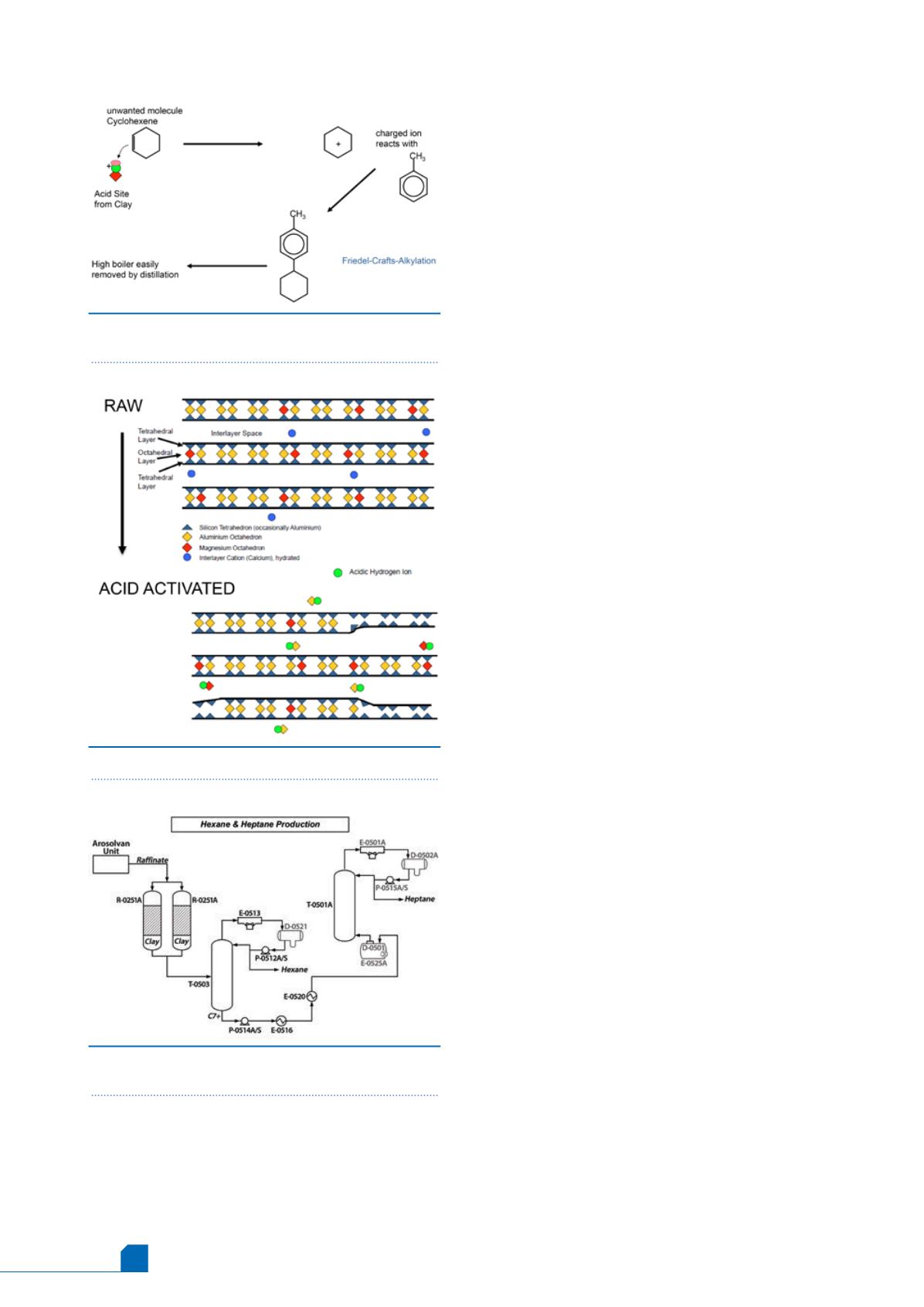
Figure 3.
Scheme interpretation of the process flow
from the solvents production (hexane and heptane).
Figure 1.
Mechanism of aromatic purification by
olefin removal.
Figure 2.
Acid activation of mineral catalyst.
volume. BASF uses a special clay, activated to a
higher degree than the prior product, F-24. F-24
has been considered an industry standard in the
past, used in many units globally. The new BASF
clay, the basis for F-24X, is a calcium bentonite
with reduced swelling tendencies, as compared to
a sodium bentonite. A low water content of about
2% is advantageous, as more active mineral catalyst
is present and it also enables a faster startup time.
Olefin content in organic compounds is
advantageous for many petrochemical uses, so a
maximum olefin content is needed, which is
measured by titration with bromine and
characterised by a bromine index (BI; BI = 1 stands
for 1 mg Br
2
needed for the titration of 100 g of
organic compound). Typical maximum
specifications for a bromine index for organic
compounds containing olefins for various
processes are between 10 and 50.
New mineral catalysts for aromatic
purification
The new mineral catalyst consists of a specially
activated natural montmorillonite, activated in a
multi-stage process using sulfuric acid. BASF has
developed a new high acidity granular catalyst
version called F-24X, which has an activity level
that is 40 - 50% higher than conventional catalysts.
Galp, after careful consideration with respect
to expected performance, ease of construction
and operation, and after a feasibility study,
decided to install the F-24X mineral catalyst, in
order to achieve a longer unit lifetime. The basic
design parameters for the unit were provided by
BASF, based on Galp’s process data.
The system was successfully sock loaded by
Galp, based on prior experience. After successful
commissioning, the F-24X mineral catalyst was
started up, and the parameters of the purification
were carefully monitored.
Case study
In this case study, the evaluation of the
performance of the new F-24X clay has been
compared with the standard F-24 system.
Alternatives
The application of other removal technologies,
such as selective hydrogenation of olefins, results
in hydrogen usage, and the need for a trickle phase
reactor system. Catalytic removal of olefins using
Friedels Crafts alkylation on a mineral catalyst
(activated clay) is a method that results in
significant advantages, particularly if the alkylated
compounds can be removed using downstream
distillation. It is important to achieve a long
lifetime, as every changeout of the catalyst is
costly. Figure 1 shows a scheme of Friedels Crafts
alkylation of the olefin cyclohexene, with toluene
forming the high boiling alkylates.


