November
2016
HYDROCARBON
ENGINEERING
80
assurance is an umbrella term covering any issue
affecting the safe and economical transportation of oil
and gas from reservoirs to the refining stage. Flow
assurance includes many complex issues, such as
corrosion, erosion, vibration‑induced stress, liquid
slugging, emulsions and the formation of different
chemical deposits in pipelines including wax, hydrates,
asphaltenes, naphthenates, paraffins and scales.
Critical requirements
Reducing costly flow assurance issues has never been so
critical, owing to the decline in oil and gas prices,
together with the increased focus on the environment
and health and safety concerns. If potential flow
assurance issues are undetected early on at the
upstream stage and left unmitigated, these can lead to
pipeline blockages, catastrophic failures, loss of
containment and shutdown.
As the oil and gas industries access deeper waters
and more hostile environments, subsea pipelines are
even more susceptible to flow assurance issues. The
development of unconventional reserves such as shale
reservoirs, heavy oils, tight gas and oil, and coal bed
methane bring new flow assurance challenges. The
mitigation of flow assurance issues can be a
combination of mechanical and chemical solutions.
Mechanical methods tend to be expensive and
distributive to production whereas chemical solutions
can be used to prevent issues from occurring.
Chemical treatment programmes devised to mitigate
flow assurance issues may be developed, which may
result in continuous injection – common for upstream
production – or intermittent injection depending on
requirements and flow composition. For flow assurance
risks, such as hydrate control, high volumes of chemicals
(i.e. methanol or glycol) may need to be injected. For
example, methanol injection can be up to 40% by volume
of the liquid present; this then exacerbates other flow
assurance issues with multiphase flows such as slugging.
Some upstream processing facilities can recover
these chemicals for re-injection to reduce costs and
reduce issues for downstream processing and refineries.
Optimal chemical dosing will vary over the lifetime of a
well, and the choice of chemicals will change
depending on the process fluids and production rates
to ensure production optimisation, asset integrity and
low flow assurance risks.
Chemicals, which are injected upstream, can have an
impact on downstream processing facilities, including
effects on catalysts and refining processes. Therefore,
considerations should be given to the selection of
upstream chemicals injected and volumes injected.
There is no ‘one size fits all’ approach to the selection
of suitable chemicals or combinations of these, but
laboratory tests using sampled production fluids can
help optimise the chemical selection and reduce the
amounts of chemicals required for injection. Some of
the chemicals added can affect inline sensor
technology that is used to measure production flow
rates and identify flow assurance issues. This can make
it difficult to confidently rely on measurements to
control chemical injection rates.
For example, the under-injection of chemicals, for
scales or paraffin control, can result in reduced
production and profits due to uncontrolled buildup in
pipes, as well as restricted throughput and the potential
blockage of the pipe completely. If buildup occurs over
a prolonged period of time, production may be halted
to undertake a batch treatment process to remove the
coatings. Under-injection of corrosion inhibitors may
result in halted production to evaluate pipeline
integrity and replace affected components.
Under-injection may save on operational costs but
ultimately can result in reduced production, increased
maintenance costs and increased risks to assets. On the
other hand, over-injection of chemical additives
increases operational costs but can reduce production
downtime, enabling higher production and asset
protection. Over‑injection can also lead to issues with
the effectiveness of downstream processing.
Operators are keen to reduce operational costs and
increase production, but they must also balance the
economics for recovery in today’s challenging economic
environment. There are many organisations offering
solutions for the management of chemical injection
programmes to mitigate issues, but they are limited by
the lack of real time data to effectively optimise the
selection of chemicals and dosing.
Sampling challenges
The lack of real time data to determine effective
mitigation, and develop intelligent feedback for
controlled chemical injection, is recognised as a major
barrier to successful flow assurance strategies that
ensure safety, reduced production cost, increased
production and asset management. Instead, there is a
heavy reliance on irregular fluid sampling and/or
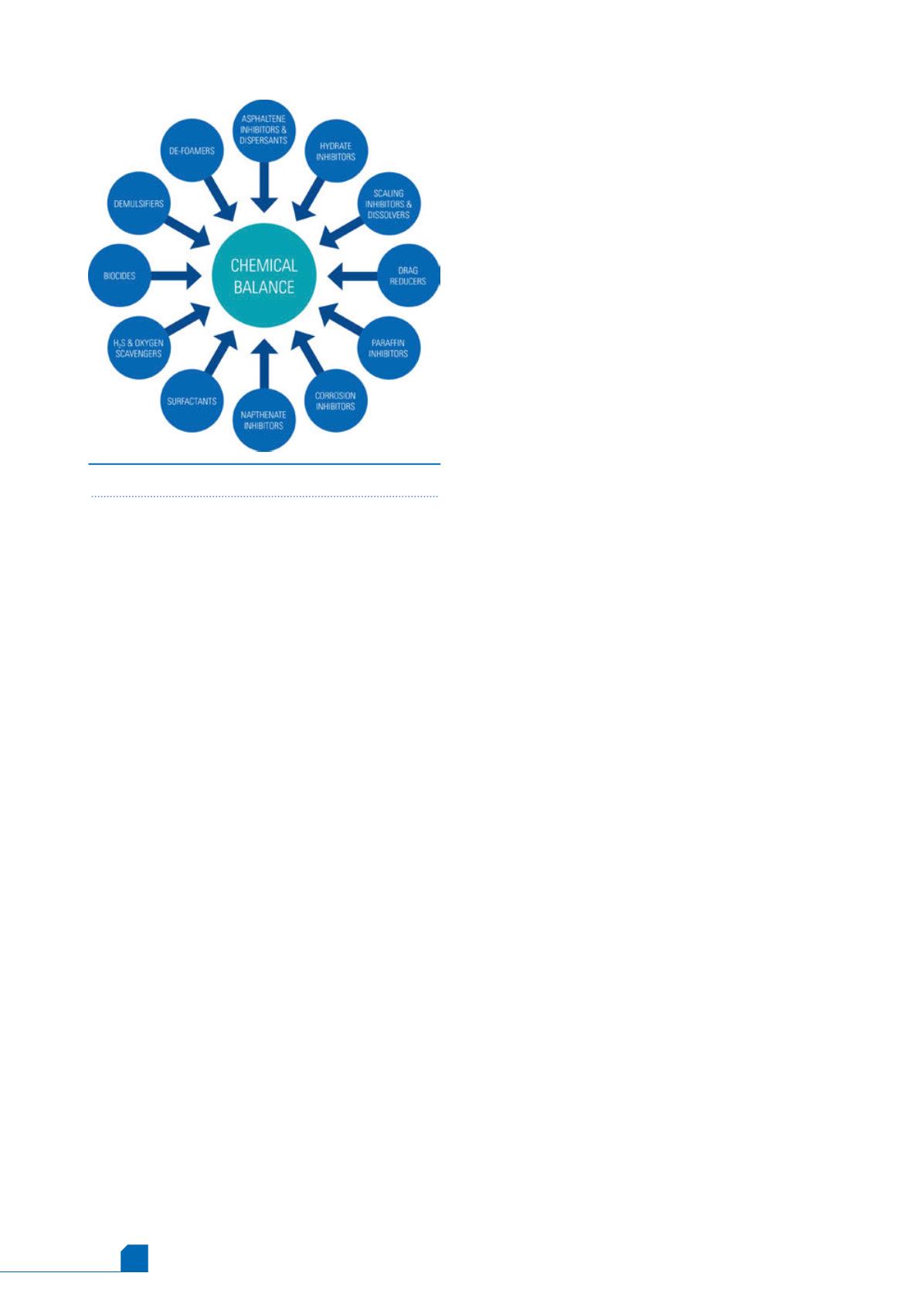
Figure 1.
The chemical balance.


