November
2016
HYDROCARBON
ENGINEERING
52
eliminate the requirement for the installation and costly maintenance of
pressure relief valves, and the emission of gases.
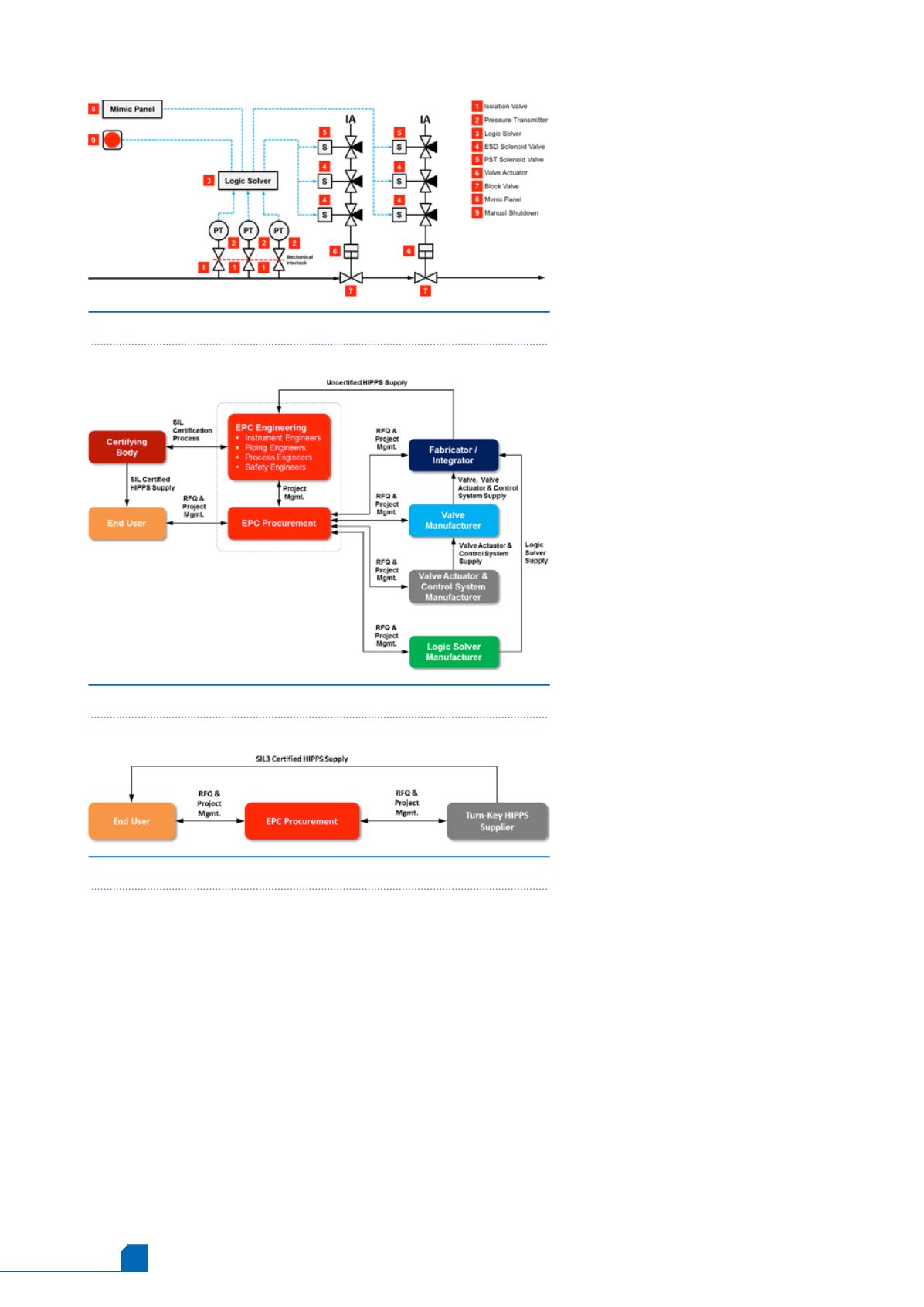
SIL 3 certified HIPPS comprise a number of various components and
instruments, including the principal items, as shown in Figure 1.
These items, together with others as required, are designed in such a
manner in order to protect against overpressure incidents, or to
drastically reduce the possibility. It is important to understand that a
HIPPS includes all the components necessary to reliably achieve the
valve failure position.
Turnkey HIPPS suppliers, such as Paladon Systems, manufacture and
supply the complete package together with all the documentation
required for an SIL 3 certified HIPPS.
Block valves
Two block valves are supplied in series to increase reliability. Although
the end user specifications for HIPPS are often unique for each specific
Figure 1.
Schematic showing the major components of a typical HIPPS.
Figure 2.
A traditional procurement cycle for HIPPS.
Figure 3.
An optimised procurement cycle for HIPPS.
application, the most common type of
block valves used are trunnion mounted
double-block and bleed ball valves, as
they have higher reliability and lower
operating torque requirements when
compared to other types of ball valves.
Often, end users will specify a preferred
manufacturer.
Valve actuators
The valve actuators can be either
pneumatically or hydraulically powered;
however, this article will focus on
hydraulically powered HIPPS since they
have better controllability, produce less
noise during operation, and are lighter
and more compact than pneumatically
powered HIPPS. Scotch-yoke valve
actuators are most often specified as
their torque output characteristics
closely match the operating torque
requirements of ball valves. Spring‑return,
fail-close valve actuators are always used
as they will reliably close the block
valves on command, on loss of command,
on loss of electrical power, and on loss
of either the pneumatic or hydraulic
supply.
The valve actuators will be CE, PED,
SIL and ATEX certified and will typically
be required to force the block valves
closed within two seconds of an over
pressure event.
Hydraulic control system
Leading designers and manufacturers of
HIPPS typically employ manifolded
hydraulic control systems. When
compared to piped surface mounted
designs, manifolded systems:
n
n
Are more compact, allowing for
easier access to components requiring
local control.
n
n
Increase reliability by reducing the
number of fittings and subsequent
possible leak paths.
n
n
Increase ruggedness by eliminating
exposed and fragile piping.
n
n
Reduce and simplify maintenance
activities.
Partial stroke testing
Whilst this is part of the hydraulic
control system, partial stroke testing
(PST) forms a large part of the integrity
and performance of a HIPPS system. Right
at the very start of Paladon Systems’
HIPPS design stage, discussions with
leading instrument engineers throughout
the world were initiated to determine


