November
2016
HYDROCARBON
ENGINEERING
42
between general or uniform corrosion and localised
corrosion such as pitting and crevice corrosion. Non‑stainless
materials suffer mainly from uniform corrosion, whereas
metals forming oxide layers that adhere to and passivate the
surface are prone to localised corrosion.
Flow accelerated corrosion
Flow accelerated corrosion (FAC) describes the removal of
the protective oxide layer on a metal. The speed of this
process is affected by the oxygen content, the flow
velocity and, to some extent, the chloride content. The
formation of a calcareous layer due to high carbonate
hardness of the water reduces, or can even prevent, FAC.
The influence of oxygen can be seen in the following
example: water with an oxygen content of less than
20 parts per billion (ppb) and a flow velocity of around
15 m/sec. will typically see a corrosion rate of around
0.01 mm/y. However, increased oxygen content can see the
corrosion rate rise to several mm/y, which will present a
significant challenge to the process.
Fortunately FAC only poses a real issue for low carbon
steels and cast iron. Increasing the chromium content or
using stainless steel will largely eliminate the vulnerability
to flow accelerated corrosion.
Erosion
Pumps that are used to transfer fluids containing abrasive
substances, such as sand, can experience significant levels
of erosion, especially in areas with high flow velocities. This
can be seen in the oil and gas industry where injection
pumps are employed to force water back into the oilfield
and, thus, maintain the pressure, which is needed to lift the
oil to the surface. The entrained sand particles act as an
abrasive and the high working pressures only serve to
compound the issue.
From a pure design standpoint, pump manufacturers in
this field effectively have two options to minimise the
erosion:
n
n
Reduce the flow velocities in every part of the pump.
n
n
Design the pump in such a way that the flow velocities
through the close running clearances are low.
However, in most cases, the specifications required for
the application will prevent either of these solutions from
being implemented. Coatings with high erosion resistance
in selected areas of the pump are a proven solution in
these applications.
Erosion-corrosion
In operating conditions where both erosion and corrosion
are present, the degradation mechanism can become very
complex and depend on the type of substrate and fluid
chemistry. Corrosion may create oxide layers with low
adherence to the substrate, which is prone to erosion, or
erosion may damage the passive layer, leading to an
activation of the surface, which accelerates corrosion. In
this case, surface protection regimes are often the best and
sole option.
Cavitation
Most commonly seen on the pump impeller, cavitation is
caused by a pressure difference, either on the pump body
or the impeller. A sudden pressure drop in the fluid causes
the liquid to flash to vapour when the local pressure falls
below the saturation pressure for the fluid being pumped.
Any vapour bubbles formed by the pressure drop are swept
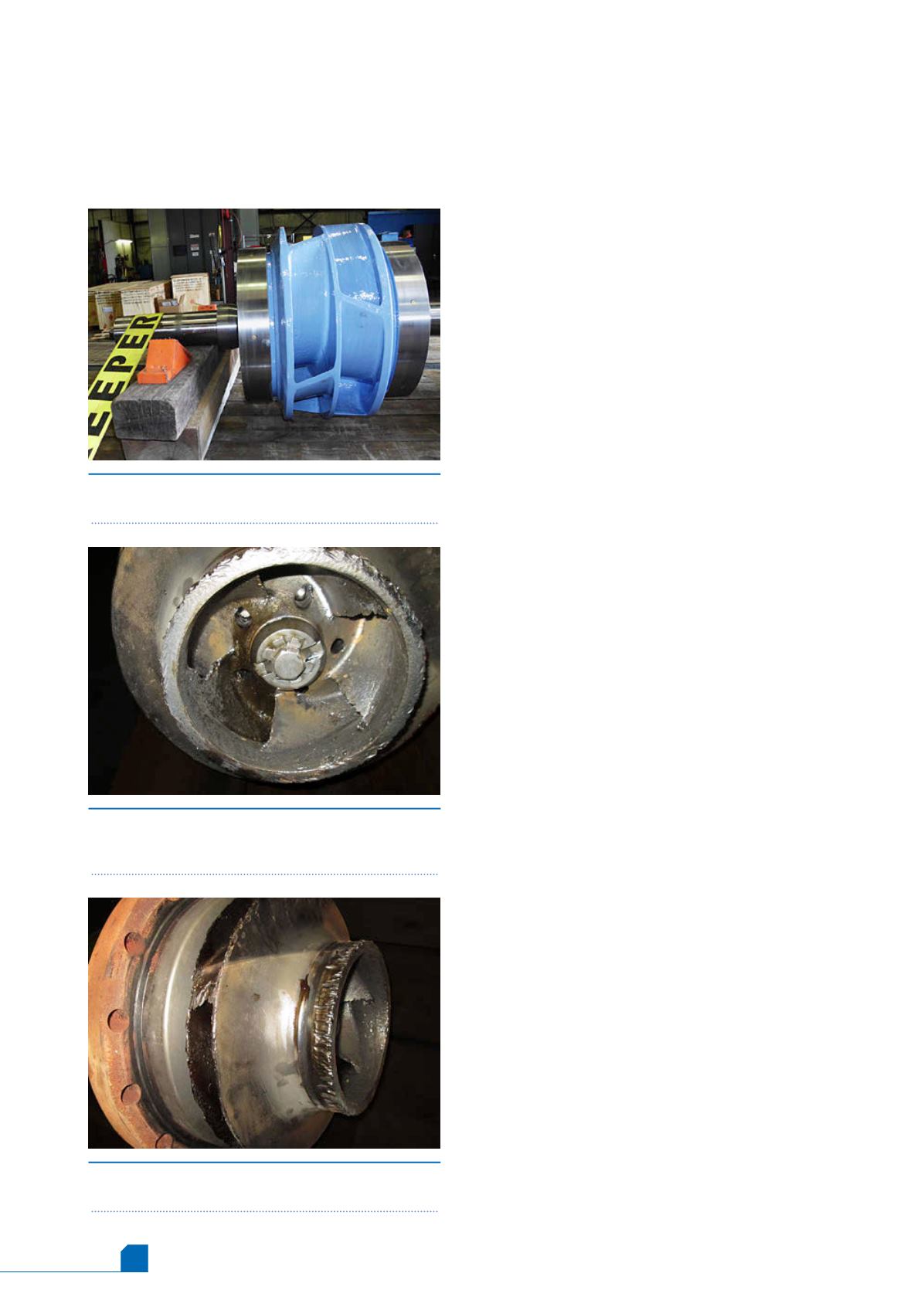
Figure 1.
Coating technologies offer improved
performance and durability.
Figure 2.
In situations where erosion-corrosion
is evident, specialised coatings may be the best
solution.
Figure 3.
In order to prevent erosion-corrosion issues,
specialised coatings can provide a safe solution.


