November
2016
HYDROCARBON
ENGINEERING
48
there may be a high volume percentage of sand
contained in the heavy crude oil, which can be quite
expensive to remove. In order to remove the sand from
the oil one has to steam it, get the oil to rise to the top,
and skim it off in a steam assisted gravity drainage
(SAGD) process.
PC pumps are an ideal solution for these aggressive
oil and gas fluids and oilsands. The pumps convey the
hydrocarbon media using a rotor that turns in an
oscillating motion within a fixed stator. The
geometrical mating of the rotor and stator forms
conveying chambers. The pump’s single helix rotor with
a double helix stator always creates an open cavity,
allowing the process to be progressed or pushed
forward. As the rotor turns in the stator, the medium is
transported from the inlet to the chamber's discharge
side. This geometry reduces pulsation and shear forces,
avoiding emulsion effects with oil-water mixtures,
which have the potential to significantly hinder
subsequent mixture separation. This makes PC pumps
the best solution for handling mixtures of oil, water
and gas, along with sand content.
While the basic PC pump technology has not
changed in many years, what has changed is the new
pump sealing technology, developed in response to
worldwide environmental rules regulating leaks and the
appearance of oil stains. Today’s environmental rules
stipulate that any kind of cosmetic stain, even on
cement, is unacceptable. For example, a mechanical seal
chamber allows for a large variety of mechanical seal
types, including single, double, or cartridge design. The
seals are typically designed in accordance with the latest
edition of API Standard 682, ‘
Pumps, Shaft Sealing
Systems for Centrifugal and Rotary Pumps
’.
Another innovative modification recently introduced
is a full service in place (FSIP) version of the block design
PC pump. This design enables users to service the
PC pump by disassembling the split connecting rod and
lifting the rotor-stator assembly upwards, leaving the
pipe manifolds completely in place.
Other higher speed pump options have been used
(mainly centrifugal pumps), but these have resulted in
industry wide concern over extreme premature wear of
mechanical seals, impellers and shafts. For example,
some centrifugal pumps can operate at an average speed
of 1800 revolutions per minute (rpm) or higher,
compared to the 250 average rpm for a PC pump. The
progressing cavity pump’s slower speed results in a very
low shear action, combined with a progressive push by
the rotor-stator. This design combination will not mix or,
potentially, froth the oil, similar to what occurs with
centrifugal pumps. In addition, the slower speed means
the rotating element does not wear prematurely. This
longevity is a definite advantage, particularly with
remote pump stations.
Choosing PC pumps
A number of Canadian producers and processors have
selected progressing cavity pumps for especially
challenging oilsands applications. For example,
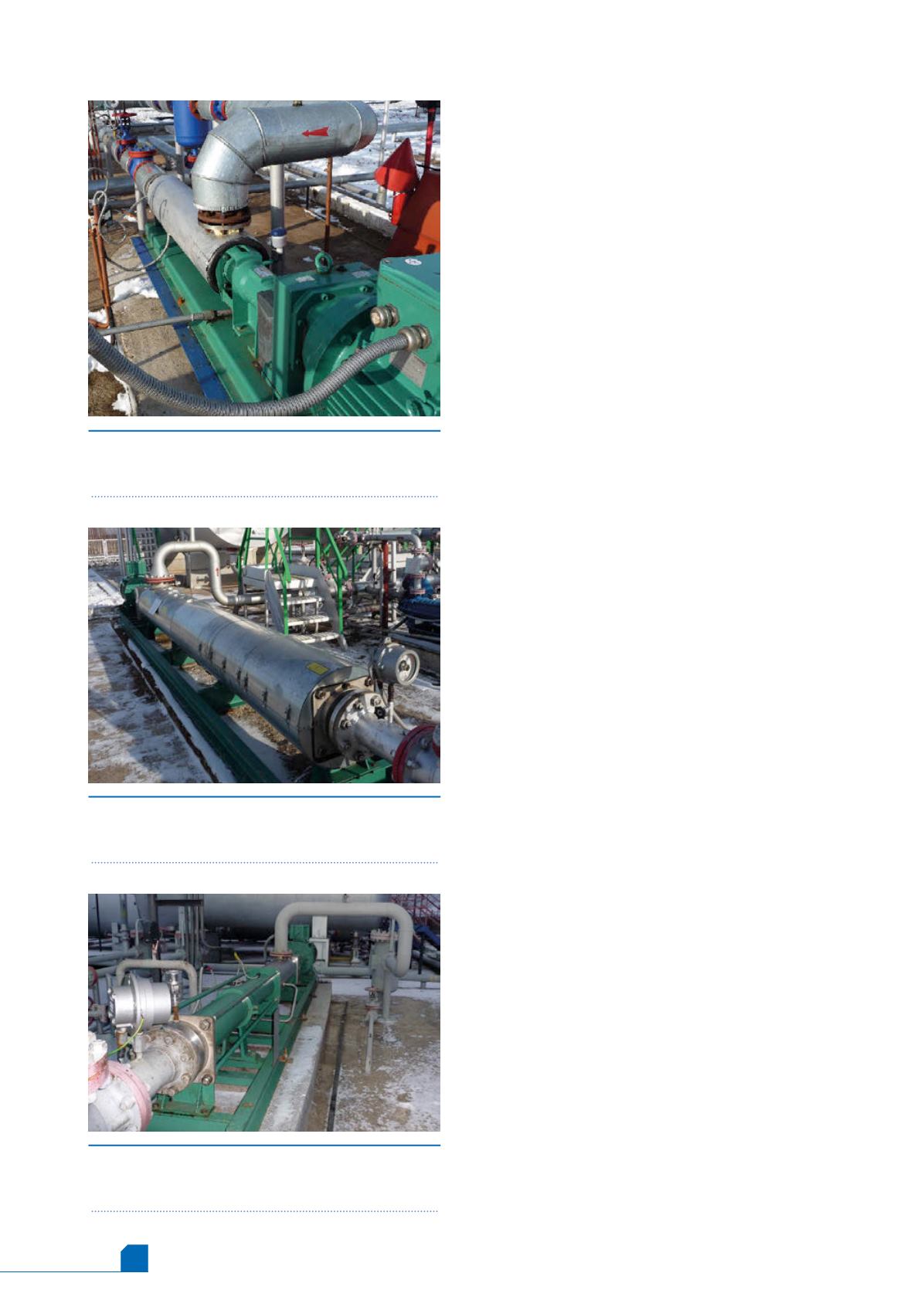
Figure 1.
NEMO SY pump for 50 - 240 gpm,
345 - 525 psi, GVF: 35% for multiphase oil, water and
gas media.
Figure 2.
NEMO SY pump for 9 - 95 gpm,
420 - 600 psi, GVF: 32% for multiphase oil, water and
gas 20 - 30% media.
Figure 3.
NEMO SY pump for 195 - 415 gpm, 270 psi,
GVF: 85% for multiphase water, gas, crude oil and H
2
S
media.


