November
2016
HYDROCARBON
ENGINEERING
60
The company selected ValvTechnologies’ RiTech® coating
technology and V1-2 metal seated ball valve design, and
were very satisfied with the quality assurance/quality
control (QA/QC) and stringent zero leakage testing
performed.
A 24 in. 300 lb metal-seated V1-2 valve was designed
and manufactured by ValvTechnologies, and a hydraulic
Moog actuator, hydraulic power unit (HPU) system and
the automation were designed by Donald Marek and
fabricated by Control Fluids, Inc. of Beaumont, Texas. The
Eads Company, a ValvTechnologies distribution partner
and integrator, provided the package as a complete
system and facilitated the final product acceptance test
prior to delivery to NatureWorks.
Case study: teamwork builds success
Aftermarket service and repair is also crucial in the
effort to ensure customer’s concerns are addressed and
plants are properly maintained and continue to run
safely and reliably, ensuring lower total cost of
ownership.
During a scheduled outage, a large plant discovered a
valve that would not move. Upon further inspection the
customer found a damaged coupler on the valve’s
mounting bracket. Assuming this damaged coupler was
causing the valve to lock up, the company decided
against purchasing a new valve and instead simply
replaced the damaged mounting bracket. Preparing to go
back online, the company found that the valve would
still not function.
Planning for outage season can be difficult enough
without an unexpected setback or unplanned
costs. Unplanned shutdowns cost plants millions of
dollars; to prevent paying this high cost, an immediate
shipment of a ValvTechnologies' V1-1 zero leakage metal
seated ball valve was required to avoid extended plant
downtime.
The request was received on a Saturday and
ValvTechnologies assembled a cross-functional team to
provide the plant with an immediate solution.
Representatives across the entire organisation, including
the shipping, warehouse and service departments, were
called to the Houston office to solve the problem. The
team was able to identify, assemble, test and ship a
replacement V1-1 valve by the end of the day that the
emergency request was received. The plant received the
V1-1 valve on the Monday morning and immediately
installed it. The new valve functioned well and the
company was able to bring the plant up, saving thousands
of dollars in potential downtime and revenue loss.
Case study: service and repair
ValvTechnologies has supplied almost 250 000 severe
service isolation valves, which are expected to last
between 20 and 40 years of almost continuous
operation. Just like any machine, the valves should be
inspected and serviced to maintain their performance
throughout their operating life. The company's
Aftermarket Service & Repair Department plays an
important support role, providing inspection and
product servicing for companies.
One of these companies is a large refinery in the
Texas Gulf area. The refinery has several hundred valves
installed – many having been specially engineered
designs with unique construction materials. A large
number of these valves have been in service for more
than 15 years. ValvTechnologies began discussions with
the refinery managers about how the company could
help refurbish these valves during a large multi-unit
plant outage early in the following year. For many
months the companies held onsite inspections of the
equipment and organised numerous follow up planning
meetings with the personnel that were determining the
outage schedule. From these meetings, the refinery
developed a detailed valve list that consisted of several
dozen older valves designated for service and repair.
With this list, ValvTechnologies designed an outage
support plan to receive the used valves and restore
them to 'like new' condition. This plan was a major
challenge as there was only one week to turnaround
each valve, leaving little time for delay or error.
The company managed almost all of the pre-outage
and in-shop planning and work flows. The project was
watched around the clock, seven days a week to ensure
success. Numerous aftermarket service and repair
personnel assisted in the preparation and execution of
this large project, alongside several other departments.
In particular, assembly and test personnel from the
company's shops worked 12 hour days to ensure the
valves were repaired on time. Inspectors visited daily to
check on the status of the valves in-process and confirm
that progress was being made. The end result was that
all valves were successfully serviced and repaired and
returned to the refinery ahead of schedule.
Conclusion
As a result of supplying the right metal seated ball valves
in the most difficult severe service applications, oil and
gas companies can take advantage of higher reliability,
increased safety and additional plant efficiencies.
Recommendations and technical expertise ensures
companies in the oil and gas industry that face tough
challenges are able to achieve peace of mind.
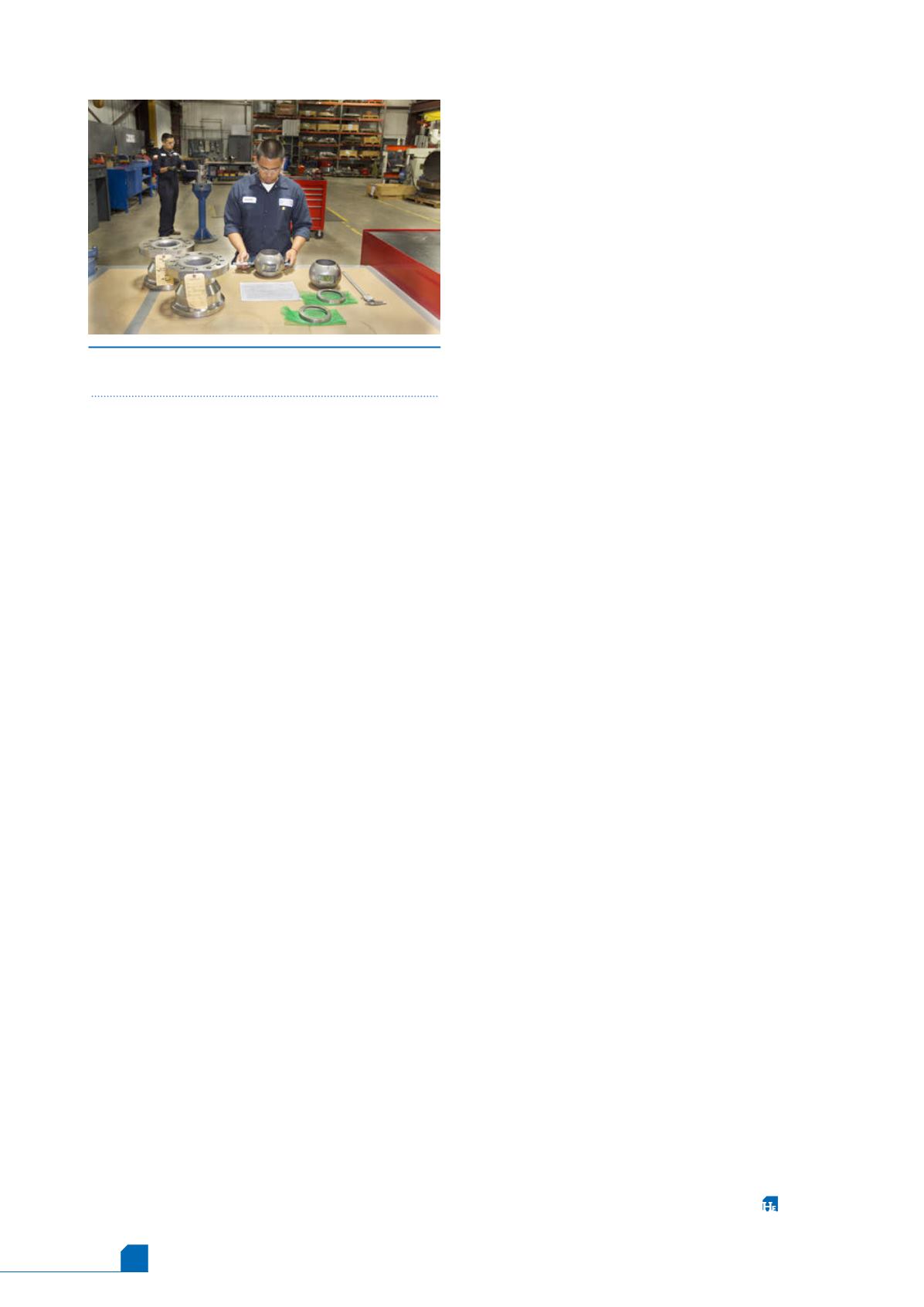
Figure 4.
Aftermarket service and repair is crucial to
support the industry’s most difficult challenges.


