November
2016
HYDROCARBON
ENGINEERING
32
installing scaffolds and climbing within structures inherently has
an impact on the space, the remediation of which is typically
accounted for in the inspection project budget.
Sky-Futures has worked closely with Flyability to develop a
method for performing high accuracy confined space inspections
without the need for manned entry. The hardware used for this is
the Elios unmanned aerial vehicle (UAV), a unique device with a
number of industrial, emergency response, humanitarian and
environmental applications. The Elios is a quad-copter surrounded
by a carbon fibre protective cage with the ability to rotate around
X, Y and Z axes. This unique design allows the Elios to interact
with objects without disturbing its ability to fly safely. Flown in a
skilled manner, the device can navigate complex spaces, relaying
first person view back to the pilot and other stakeholders.
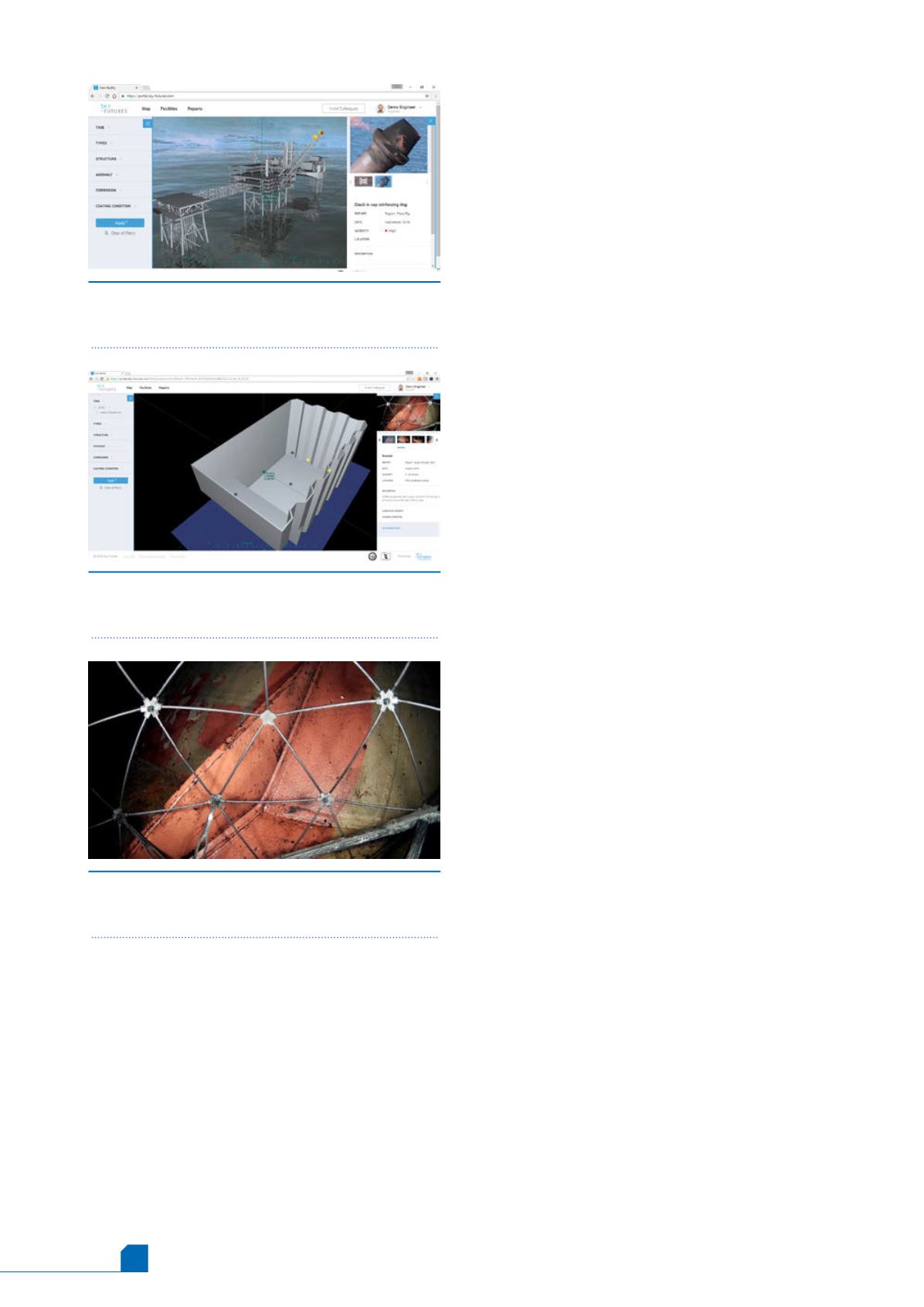
Figure 1.
The Sky-Futures inspection portal: Hangar
showing typical offshore inspection results. Courtesy
of Sky-Futures.
Figure 2.
Cargo tank inspection showing stiffening
bracket welds in the Sky-Futures Hangar inspection
portal. Courtesy of Sky-Futures.
Figure 3.
Example of imagery captured by the
Flyability Elios UAV and reported in the Sky-Futures
Hangar inspection portal. Courtesy of Sky-Futures.
For the past 12 months, Sky-Futures and Flyability have worked
together at a test facility, designing and testing procedures for
confined space inspection of industrial assets. The Sky-Futures
350 acre test site provides unsurpassed access to various realistic
scenarios, including an offshore platform and a ship. Within these
spaces, operators are able to fly and test the UAV to its limits under
controlled parameters.
New technology
The introduction of new technologies to hazardous industries has to
be carried out with diligence. There is a lot at stake when performing
inspections, and the replacement of a person with a robot requires
great care. Sky-Futures set out to discover whether a person could be
replaced by a robot in a confined space. The key questions that arose
included:
n
n
Could one be sure that they had covered the entire surface area
that needs to be inspected?
n
n
Is the imagery captured of sufficient quality to detect anomalies
by the engineers viewing the data remotely?
n
n
Where is the UAV – and, therefore, the anomaly that has been
identified – located?
n
n
Can one safely recover the UAV through flight, considering that
manual retrieval would make the exercise futile?
It must be noted that currently the Elios UAV is not EX rated and,
therefore, the confined space must be emptied of flammable
materials before UAV inspection is carried out.
Overcoming challenges through robust
procedures
The inherent benefit of using a safer unmanned approach to confined
space entry is clear. However, the quality of the inspection results
must meet or exceed that of manual inspection.
In a confined space, GPS coordination is not possible. To know
where one is located within the space, the pilot and inspection
engineer have to rely on detailed flight planning, knowledge of the
contents of the confined space and strict flight and communication
processes. This is not dissimilar to the approach already used during
outdoor UAV inspections on major hazard facilities around the world.
Inspecting live flare stacks onshore and offshore requires the same
strict adherence to protocol as negotiating a confined space.
The meticulous approach used by UAV inspectors is enhanced
when applied to confined spaces using a flight/review loop. When
the UAV is returned to the pilot, the onboard HD footage is reviewed.
This provides an extra layer of quality to ensure that the location is
checked and no anomalies were missed during the viewing of the live
relay at flight time. This process has been extensively blind tested to
ensure its effectiveness. Using this methodical approach, the
company is able to ensure it is always aware of the location of the
UAV, it has a double sweep of anomaly detection using live and
offline footage, and drawings are updated during the inspection to
account for anomalous objects that could be a hazard to flight. In this
way, the challenges of introducing a robot to perform confined space
inspection are overcome.
UAV inspection advantages
The benefits of using a UAV to perform inspections are extensive. In
confined spaces these benefits are magnified. As is already the case
for the many companies making use of UAV inspection, typically, the
number of site visits can be greatly reduced if the company is able to
give large numbers of stakeholders eyes on their asset from their
desktop. The nature of UAV inspection provides the users with a high


