November
2016
HYDROCARBON
ENGINEERING
38
Sensors and modelling: a suggested
solution
The sensor suite provided by the University of
Southampton enables measurements to be taken that
detect when metallic surfaces are wet and thus prone
to corrosion, identify metal ions with good sensitivity
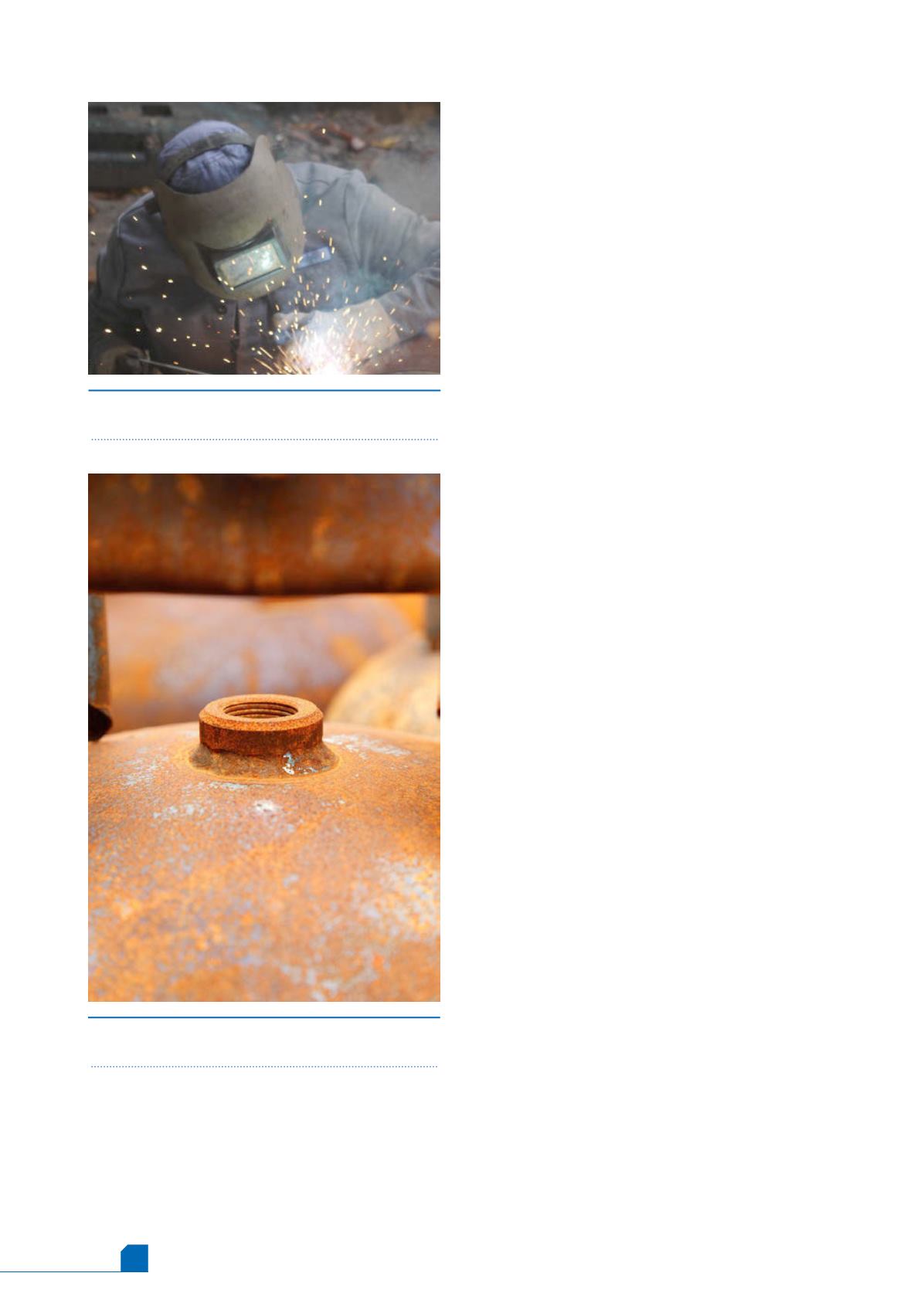
Figure 3.
Corrosion protection for pipework often
relies upon the use of protective coatings.
Figure 4.
CUI can affect any metallic pipework or
storage tank.
and a well defined electrode response, and assess
the aggressive nature of the microclimate. As the
degradation process caused by corrosion under
insulation affects any protective systems applied to
the metal, the incubation time between coating
failure and corrosion initiation is dependent on the
material and surface condition. Once corrosion
starts, sites will continue to grow if the environment
remains stable, and active sites that grow to a
diameter of 50 - 100
µ
m have a high probability of
further damage, such as local general corrosion or
cracking and fatigue issues. The sensor can detect
when the local microclimate contains water and
when it is dry, so it provides a marker of when the
protective coating is initially or repeatedly
compromised, allowing a damage calculation to be
made based upon the cumulative time when the
metallic material is wet.
The accompanying corrosion modelling tool will
output estimates of both current and future
corrosion damage, indicating the confidence level
for each assessment. These assessments can then be
used in parallel with a maintenance strategy that
schedules work based on actual conditions, rather
than on a time-based inspection and repair policy.
The corrosion model is created using multiple data
sources, including information recorded by the CUI
probes and environmental monitoring sensors,
together with current and historic maintenance data.
Based upon the data gathered, plus damage
algorithms, the model can estimate current
corrosion damage, and these estimations can help to
enhance the management and control of protective
coatings, corrosion, and related structural damage.
Looking to the past, and the future
Using the historical data allows probabilistic
corrosion models to be generated: these analyse
records and estimate, on the basis of past data, the
probability of corrosion occurring again. The
resulting models can be used to quantify structural
reliability assessments and asset management
strategies across multiple types of structure, and can
make estimations for both generalised and localised
corrosion. Localised corrosion is a particular threat,
since it is often hard to detect and can be severe,
with a relatively short time frame to structural
collapse.
As well as modelling existing damage and
predicting future damage, the data recorded by the
sensor can be used to undertake life data (or
Weibull) analysis. This analysis can be used to
predict the life span of material or of a component.
Life data can be measured in hours, miles, cycles, or
any other metric that can be applied to the period
of successful operation of a particular material or
component. Since time is a common measure, life
data points are often called ‘times to failure,’ so a
prediction might conclude that the time to failure
for a pipework bracket develops within 1000 hours


