November
2016
HYDROCARBON
ENGINEERING
34
quality visual data set. Imagery can be accessed by all manner of
stakeholders. Robotically captured data, coupled with
telemetry information, fits perfectly with modern cloud
technology. Sky-Futures delivers reports for its clients in a highly
secure cloud platform. This allows the high definition video and
high resolution images to be provided in context to clients for
rapid, intuitive access.
When considering this in the context of confined spaces, it
is only a very small number of highly skilled individuals –
typically third party contractors – that will ever see the
confined space first hand.
UAV inspection of confined spaces completely changes this.
The continuously captured high definition video and images can
be placed in context and made accessible to all parties that may
derive business benefit from it. Sky-Futures works with 3D
models to place anomaly findings onto a digital facility to
guarantee that the information captured by the UAV is totally
unambiguous. The latent benefit of this is that compounding
data over time allows stakeholders to start developing trends
throughout the findings, ultimately providing the user with
leading indicators and prediction.
The Elios’ spherical shape allows it to roll along walls, weld
seams and floors. The onboard lighting is remotely adjustable,
which allows the pilot and inspection engineer to control the
settings to capture the optimum footage for any given
environment. The onboard lighting, offset from the camera, is
particularly useful at casting shadows to highlight pitting on the
floors of tanks – something that is notoriously hard to detect
manually.
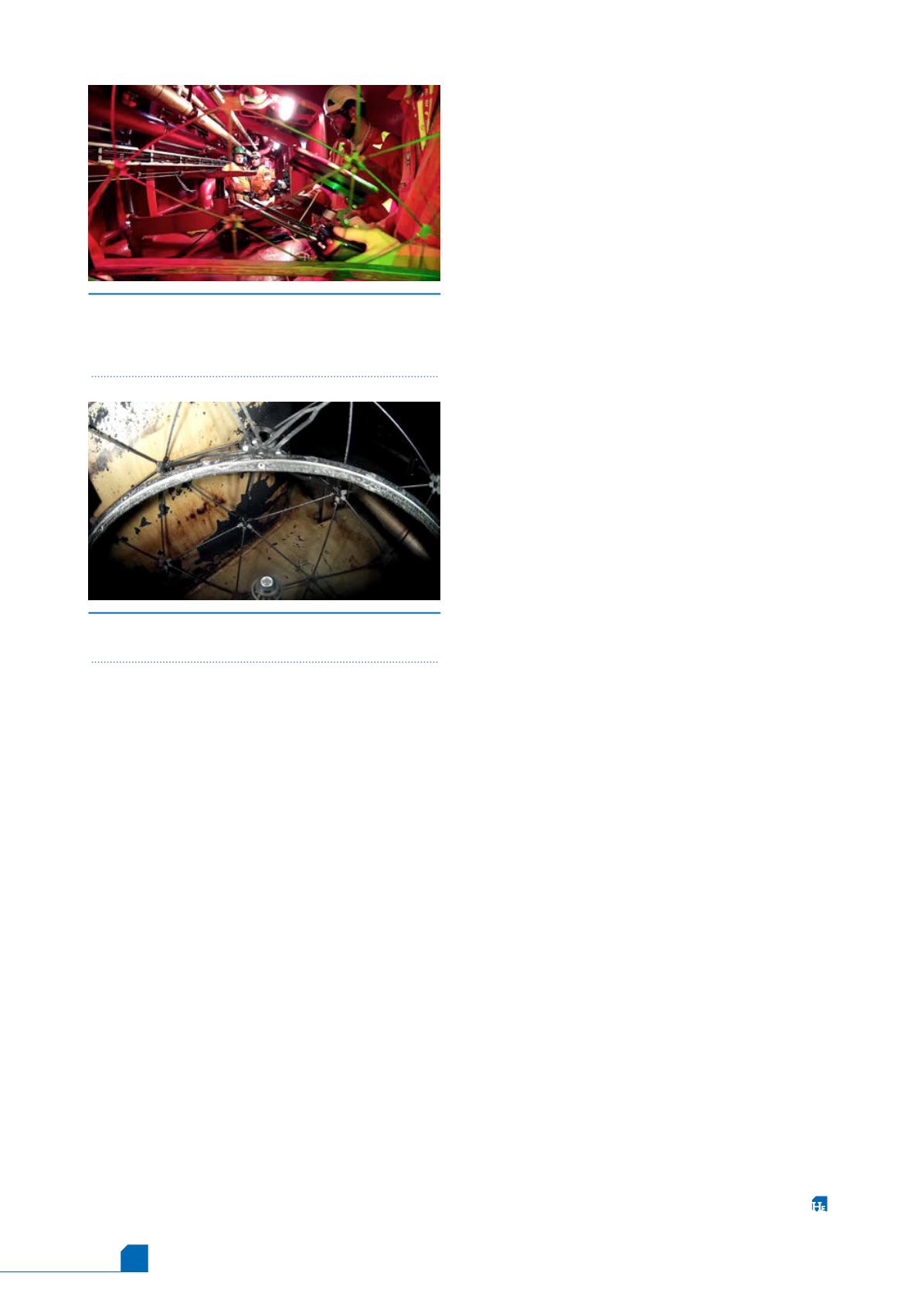
Figure 4.
A pilot and inspection engineer perform
a remote confined space inspection, observed by
the asset owner and classification body. Courtesy of
Sky‑Futures.
Figure 5.
Corrosion on the wall of a cargo tank from
the UAV’s perspective. Courtesy of Sky-Futures.
If no anomalies are discovered, then the inspection was a success
and facility operation can continue. If anomalies are discovered, the
project to correct the problems must be carried out safely and
efficiently. Armed with high quality footage, all parties involved in
project planning, fabrication and maintenance of the facility are able to
plan, deploy and carry out their activities safely and very efficiently.
Workers are directed to the exact spot where they are required and
there are no surprises. Remediation projects run on time and plans are
executed on budget, with no workers adding to the unfortunate
statistics of confined space injuries and fatalities.
Case study
Sky-Futures recently inspected the cargo tank of a floating production
storage and offloading (FPSO) vessel for a client in the presence of its
classification body. More recently, work has been carried out within
onshore hydrocarbon storage tanks and power plant gas turbines. The
applications of this technology and its procedures are extensive. The
results of inspections are available for scrutiny throughout the client
organisation and its surveyors or class body as required. The quality of
data captured provides the user with details on welds, corrosion,
previous remediation and other information that is critical to the safe
operation of the plant.
The FPSO is located in Europe and is undergoing maintenance and
upgrades between client leases. Downtime is being kept to a
practicable minimum due to the high value nature of the asset. The
confined space comprises approximately 9 m x 4 m x 3.5 m volume with
two corrugated walls and irregular surfaces. The ceiling supports the
above deck and, therefore, structural members run throughout.
Pipework penetrates the walls of the space and valves are present
inside the confined space, which are normally submerged in liquid
hydrocarbons. Heating pipework runs along the floor and lower
sections of the walls. This is used to maintain temperature and ensure a
viscosity of product suitable for transport out of the cargo tank, and
presents a hazard to people and the UAV as they can be damaged by
moderate force. An access hatch leads to a ladder into the space for
manual access. Together these physical components present a sensitive
and complex space that has historically been negotiated manually. For
the UAV they present obstacle challenges. Due to the lowmass of the
UAV and low flight speed, the subsequent lowmomentum cannot give
rise to forces that can damage any of the objects or substrates within
the space. The UAV does, however, have the potential to get caught on
obstacles. The flight paths were, therefore, very carefully planned and
carried out. The pilot and inspection engineer performed systematic
sweeps of the walls for general visual inspection. This was followed by
close visual inspection, adjusting light and camera settings as necessary,
with results as shown in Figure 3. The condition of welds at high stress
points were naturally of concern and the condition of toe welds of
structural braces were seen clearly, with the ability for a wide range of
stakeholders able to view video footage and photographs through the
cloud portal, as mentioned previously. A range of further observations
were made, including coating breakdown and small patches of
corrosion present on the walls near the floor, as shown in Figure 5. A
tank of this size can be inspected in detail in approximately 12 hours.
With such a large amount of footage, the importance of providing
spatial context and priority of information is clear and, thus, the power
of Sky-Futures' inspection portal software Hangar is evident.
Conclusion
Confined space inspection using unmanned aerial vehicles offers an
excellent opportunity to a wide range of industries as an inherently
safer means to assuring asset integrity of critical infrastructure.


