November
2016
HYDROCARBON
ENGINEERING
36
petrochemical, power, industrial, and onshore and offshore
oil and gas. The recent
International Measures of
Prevention, Application, and Economics of Corrosion
Technologies
(IMPACT)
study from corrosion authority
NACE International estimates that the cost of corrosion
globally is US$2.5 trillion,
2
and this figure typically excludes
costs related to individual safety and environmental
consequences.
Corrosion protection, particularly for pipework
distribution networks, is often characterised through the
use of protective coatings made from ceramics or
enamels, which attempt to provide a barrier between
the metallic surface and the environment. Cathodic or
anodic protection may also be used to reduce the
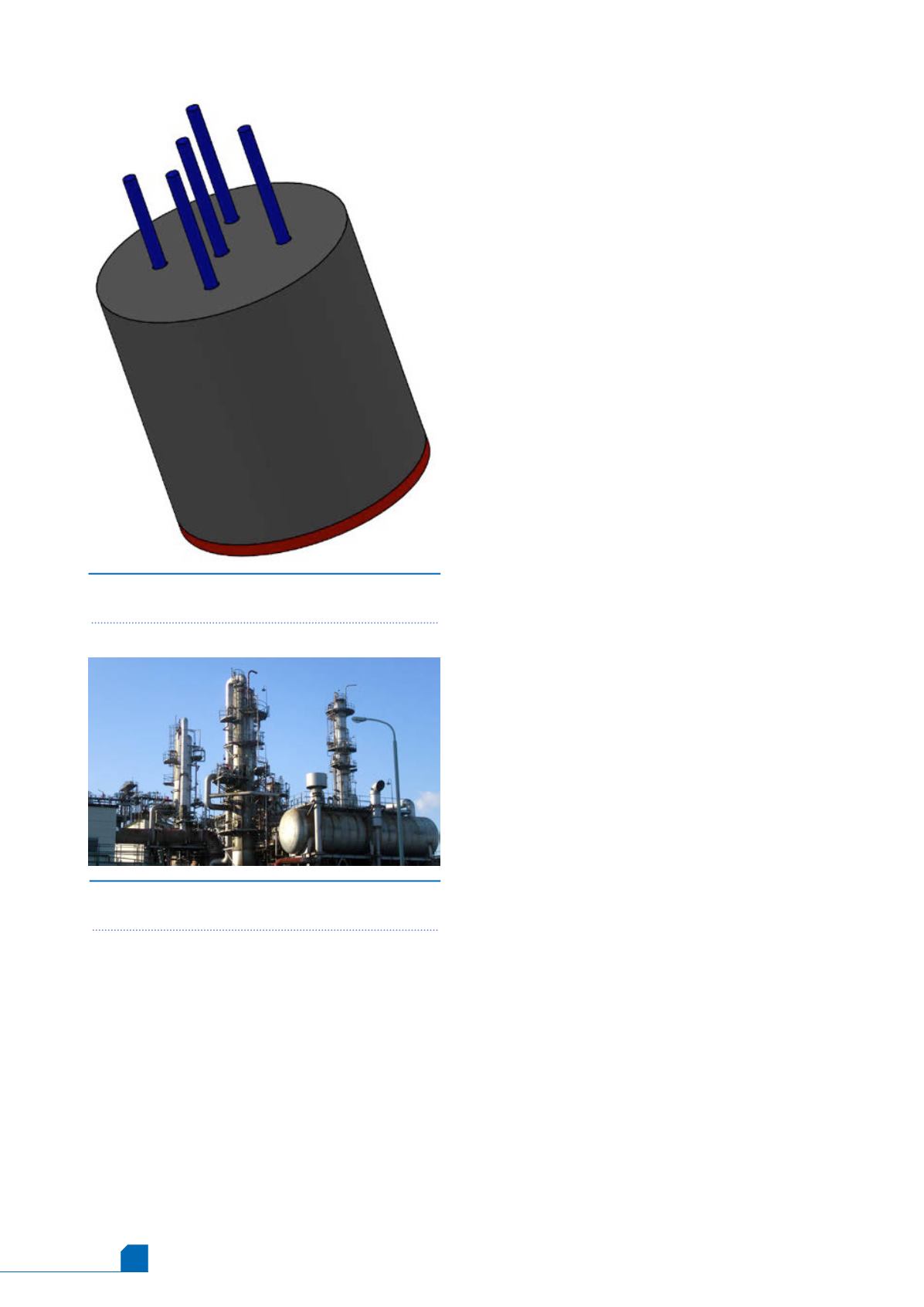
Figure 1.
An illustration of the boron-doped diamond
sensor.
Figure 2.
Corrosion prevention is a major cost across
a range of downstream industries.
corrosion rate. Applying these coatings can be costly
and time consuming, requiring abrasive pretreatment,
and environmental concerns have been expressed
about the potential toxicity of corrosion inhibitors.
The causes and challenges of CUI
CUI is caused by chemical changes in the metal ions
of a surface, and is generally associated with steel
components losing material performance due to
corrosion. Corrosion damage occurs when water
comes into contact with a metal surface, from
sources such as rain or condensation. This may be
due to degradation of a protective coating, or
failures in insulation systems such as jackets, foams
and adhesives, allowing water to infiltrate the
lagging and create a ‘poultice effect’, holding in the
moisture. The microclimate and chemistry that this
closed system creates is often very different to the
local environment, and can result in an aggressive
environment that causes pitting, crevice and stress
corrosion. CUI is often difficult to diagnose, as the
problem occurs under lagging or insulation, masking
the problem until the damage is more extensive.
The challenge of identifying, repairing and
potentially eliminating CUI has been studied for
many years. Currently, inspection of the surface is
often undertaken visually during routine
maintenance, by removing the insulation, checking
the surface condition of the base material, and
replacing the insulation. If corrosion is detected,
further evaluation may be needed using localised
techniques that require skilled interpretation, such
as ultrasonic or X-ray, thermal imaging, neutron
backscatter or pulsed eddy current instrumentation.
Both inspection and evaluation techniques, however,
are expensive and time consuming, often requiring
shutdowns, while removal and replacement of the
insulation can result in damage that actually
increases potential corrosion risk. Further
complications may arise if the system being
inspected is difficult to access, while, if only a part
of the surface is checked, it may not show corrosion
just a few centimetres away.
A move from preventive to proactive inspections
has obvious economic and operational advantages,
allowing any shutdowns to be scheduled at the best
time for the business, and supporting through life
asset management. The ability to identify and
monitor corrosion damage via in-situ monitoring and
modelling would allow maintenance to be planned,
decisions about repair and replacement to be taken
at an early stage, and might even inform future design
of systems to help avoid corrosion ‘hot spots’. To
facilitate this, Frazer-Nash Consultancy, in partnership
with the University of Southampton, is developing a
new approach to monitor and manage CUI. The new
system uses electrochemical sensors and logging
technologies, plus supporting degradation and
probabilistic models, to identify the current and
future condition of metallic areas under insulation.


