November
2016
HYDROCARBON
ENGINEERING
26
selling such a product is contributing to a highly
sceptical public that have, for years, been led to
believe that the mere presence of water in fuel is
disastrous for engines. However, experts from a
number of key companies operating within the
industry, as well as academics, have acknowledged the
significant potential of emulsified fuel. Furthermore,
they have recognised the concept and science
underpinning emulsified fuel as sound. A few have
gone on to identify the foremost issue – a regulatory
regime that prevents and disincentivises new markets,
new product entrants or even research and
development (R&D).
The fact is that, for years, the UK Government and
regulators have been complicit in closing down this
debate and, with the adoption of standards such as
EN590 for diesel fuel, this has made it impossible for
'water in diesel' emulsions to obtain approval. Simply
put, the process of emulsifying regular diesel with
water is subject to identical regulations as regular
diesel. The current ISO or DIN qualifications do not
take into account the properties of emulsified diesel
and, as such, fail on two counts. Firstly, the colour:
emulsified diesel has an opaque milky whiteness,
dependent on the amount of water blended with the
diesel (hence why it is often referred to as white
diesel). Secondly, and most importantly, the testing
method by chemical analysis that is currently used will
detect the presence of water as it breaks down the
mix into its constitute parts.
The Team Britannia project
It is common knowledge that diesel contains water (it
has been added); however, what interested the
researchers at Clean Fuel Ltd is: does it work, how
does it affect the engines (both in terms of
performance and long term maintenance) and, finally,
does it cut pollution? The first question, does it work,
has already been answered. It works so well that later
this year it will be used as an emulsified fuel to power
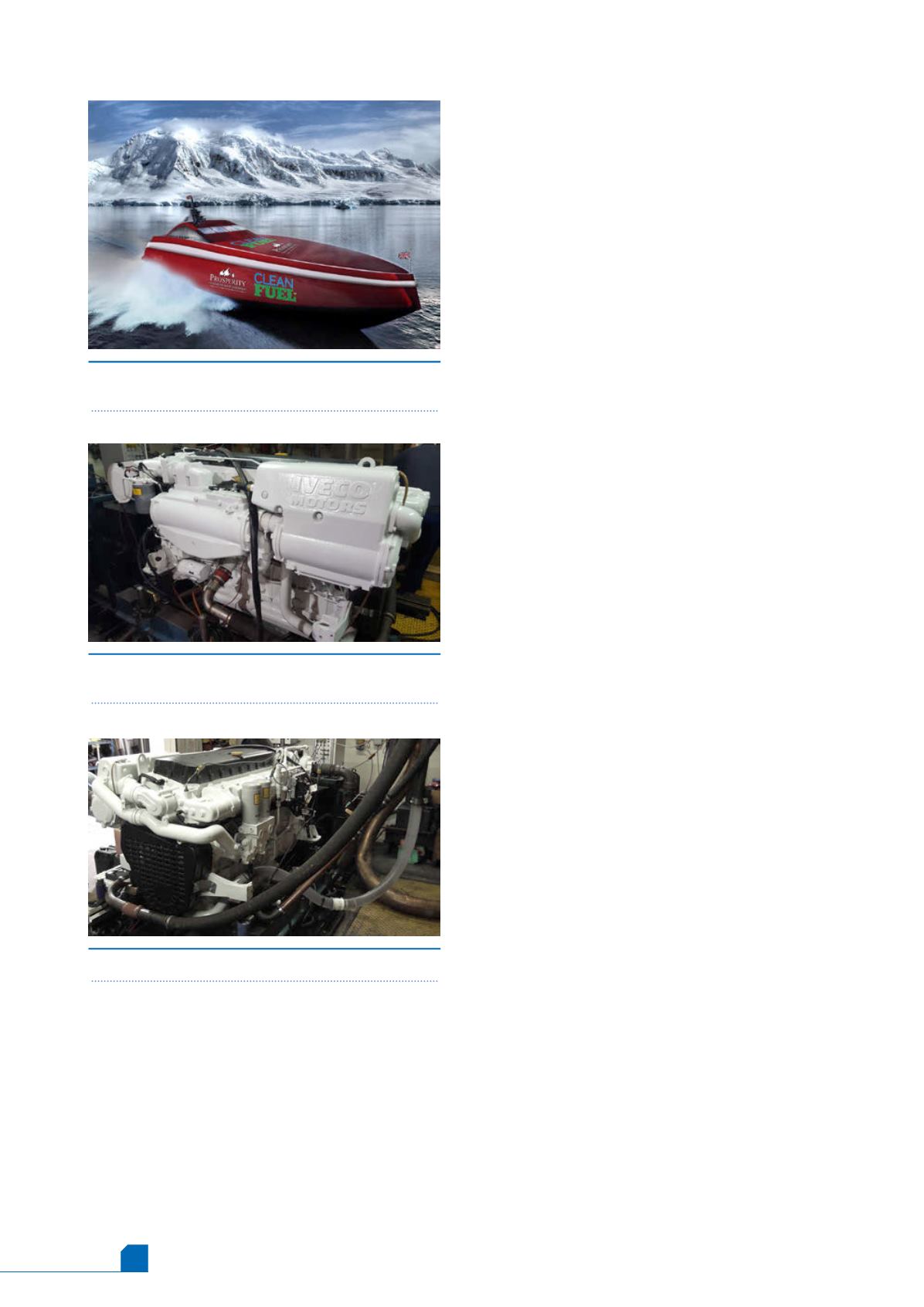
a round the world powerboat record attempt. The
voyage, dubbed Team Britannia, will be carried out in a
fuel efficient British-designed and built vessel,
overseen by naval architect Professor Bob Cripps and
his team at Longitude. The vessel is a variant of the
fast-hull displacement design, but aside from this
shares the same characteristics as a traditional boat.
Construction work on the 80 ft vessel is well
underway on the UK’s south coast at the Aluminium
Boatbuilding Company. The boat’s 38 aluminium frames
were fixed into a specially made upside down jig in
June 2016. The wheelhouse is currently under
construction and the boat's protective skin, or plating,
for the hull has been cut and is being fixed in place. In
early September the hull was turned over and the six
5833 l fuel tanks slid into place. In total there are
around 3000 pieces of metal that will be welded
together by boatbuilder Paul Johnson and his team on
Hayling Island, near Portsmouth.
Fuel performance and engine testing
The engines, two six cylinder Fiat Power Train C13 500s,
are commercially available and, apart from some slight
race tuning, are otherwise unchanged. In
September 2015, the engines were tested
independently at Hendy Power in Portsmouth to assess
fuel consumption, power output and pollution levels.
The results were nothing short of astonishing. After
warming the engine up on standard diesel, the
Clean Fuel team proceeded to test five different fuel
emulsions: 5%, 10%, 15%, 20% and 25% water. The
Figure 1.
An artists impression of Excalibur,
Team Britannia’s new boat.
Figure 2.
The Fiat Power Train C13 500, six cylinder
engine that will power Excalibur.
Figure 3.
The new engine rigged for testing.


