November
2016
HYDROCARBON
ENGINEERING
96
A complex art
Efficient and reliable hydrogen production is an exact
science that is reliant on a number of factors – and this is
where the expertise of industrial gas companies are
increasingly being recognised by the refinery market. Since
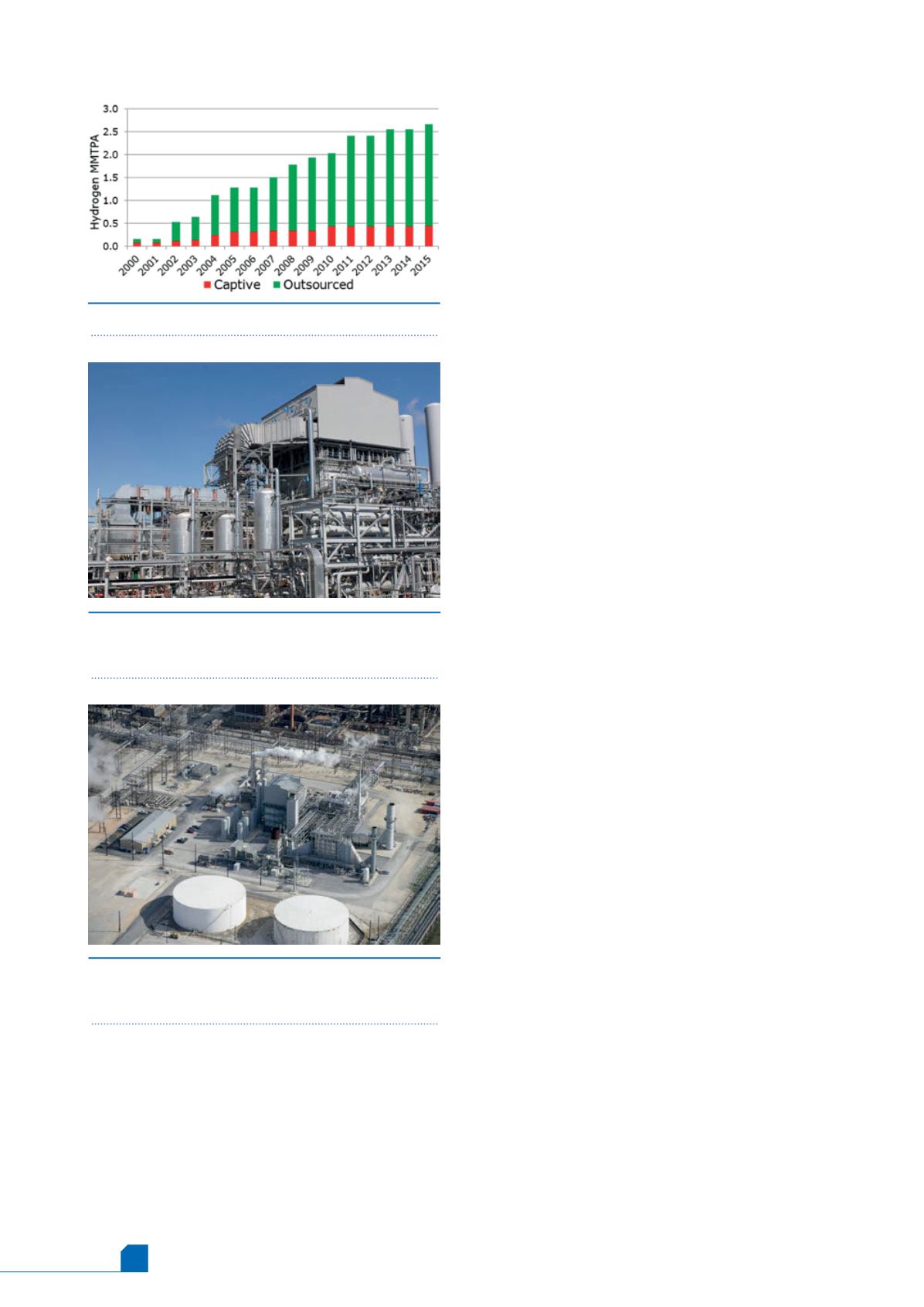
2000, the top six international oil companies have
awarded 2.7 million tpy (3 billion ft
3
/d) of hydrogen, of
which more than 80% has been outsourced to industrial
gas experts.
Air Products is one such company aiding this trend. It
has over 50 years experience in supplying hydrogen via
pipeline or from a dedicated plant located at or near a
customer’s refinery facility.
This experience, as well as the efficiencies achieved by
smart standardisation of design and technology, is
encouraging a number of refineries to purchase their
hydrogen from Air Products, rather than produce it
themselves. This is not a trend restricted to the Western
world either. In India, for example, the company is behind
the country’s second hydrogen sale of gas contract, with
clear signs that a move to buy, rather than produce, is
gathering momentum there too.
Reliability matters
One of the key factors affecting supply reliability is the
ability to balance the limitations of plant technology with
the need to operate at maximum efficiency.
The tendency with customer-run plants is to ease back
after the initial test period. By contrast, industrial gas
experts are able to use the knowledge and experience of
their engineers and operators to run plants at their limit.
This, in turn, allows them to operate typically at 3 - 5%
better energy efficiency, and with efficiency guarantees.
When one considers that energy costs account for 75 - 85%
of hydrogen production for large scale hydrogen
production facilities, this is a significant potential saving.
But, while outsourcing hydrogen presents a valuable
opportunity for refineries to achieve efficiencies, the key
driver to date has been guaranteeing reliable supply – and
this is where the plant technology itself really counts.
The two key pieces of process equipment within a
hydrogen plant – the reformer and hydrogen purification
systems – are often supplied by different parties, meaning
that if issues occur, repairs can be complex and lengthy.
Air Products has removed this risk by forming a
hydrogen alliance with Technip, combining its own
strength in gas separation technology and plant
operations with Technip’s steam methane reformer (SMR)
design and construction expertise. The partnership, which
has been running for over 25 years, has completed in
excess of 35 projects, many being >80 million ft
3
/d (or
90 000 Nm
3
/hr) H
2
.
The nature of its operations have led the way for the
sale of gas (SOG) business model worldwide, and the
company now operates the world’s largest hydrogen
pipeline which, located in the US, unites 22 hydrogen
plants, with a total capacity of over 1.4 billion ft
3
/d. It is
pipeline systems such as these that mean if an event
disrupts operations on one side of the Gulf, for example,
hydrogen can keep flowing from the other, ensuring
uninterrupted, reliable supply.
The plants themselves are also custom built to a bespoke
design, making operating trends and challenges easier to
identify and monitor. Operating and previous project
experience is fed back into the design of each new facility,
and, with a network of over 80 plants, if an issue is identified
with one plant, it can easily be addressed on the other 79.
This multi-plant execution and repeat engineering
offers a number of other advantages – not least 5 - 10%
Figure 1.
IOC cumulative H
2
awards since 2000.
Figure 2.
The Air Products Convent Louisiana
hydrogen plant supplying the Motiva refinery, and the
Air Product’s USGC pipeline system.
Figure 3.
Port Arthur II: a 110 million ft
3
/d hydrogen
plant with integrated gas turbine located at
Port Arthur, Texas, and supplying Valero Energy.


