November
2016
HYDROCARBON
ENGINEERING
98
lower capital costs. Factors such as extensive preventive
maintenance programmes and shared spare parts mean that
a reduction in operating costs of up to 10% is also
achievable.
Tailored solutions
The importance of an expert team in securing these
benefits, and ensuring a reliable and efficient hydrogen
supply, should not be underestimated, however.
Producing and supplying hydrogen is a core business to
industrial gas companies – a fact that affords them the
necessary expertise to develop tailored solutions that
can address a refiner’s long term needs.
Air Products, for example, has recently signed a long
term industrial gas supply agreement with Bharat
Petroleum Corporation Limited (BPCL) to build, own and
operate several new industrial gas production facilities
in India. The new facilities will supply industrial gases to
BPCL’s Kochi refinery, which is currently undergoing a
US$2.6 billion integrated expansion project that will
increase its crude refining capacity to 15.5 million tpy
(approximately 310 000 bpd).
Over 15 tph of hydrogen will be consumed by the new
Integrated Refinery Expansion Project, which will enable
BPCL to produce Euro 5 grade fuels while also making
propylene feedstock for a downstream petrochemicals
unit. The facility incorporates two 50% steam reformer
hydrogen trains, which have an ability to operate on
either natural gas or naphtha feedstock. There is also the
option to use refinery fuel streams as supplemental
feedstock when available.
Interestingly, a gas turbine is integrated with the
SMRs to allow the facility to be independent of the
state power grid and to operate in ‘island mode’ as
required. The hot air exhaust from the gas turbines is
used as hot air feed to the reformers, thereby improving
the overall efficiency of the combined hydrogen and
power production processes.
It goes without saying that the needs and
requirements of every refinery are different, varying
between oil companies and regions. The trend in
outsourcing hydrogen supply is a clear recognition of
the intelligent and bespoke approach that an industrial
gas expert can apply to ensuring greater reliability and
efficiency of hydrogen supply, reducing costs and,
critically, boosting the bottom line by improving per
barrel production.
But what of environmental and safety regulations?
Tackling legislation and regulations
Crude feeds are getting heavier and more sour, which in
turn means more hydrogen is required to not only
produce higher value product mixes, but also to meet
increasingly tight low sulfur fuel regulations globally.
In Europe, for example, less than 10 ppm of sulfur is
currently permitted in both gasoline and diesel. This has
steadily been falling from previous limits of 500 ppm in
the 1990s. The US is following suit and further tightening
its fuel standards with its Tier 3 programme being
implemented as of January 2017, requiring an annual
average standard of 10 ppm for gasoline here too. It is a
trend that is emerging in developing countries as well,
with India, for example, expected to require 10 ppm by
2020.
Tighter environmental regulations such as these
increase the amount of hydrogen required and make the
need for reliability and efficiency even more acute.
Refineries simply cannot afford an interruption to
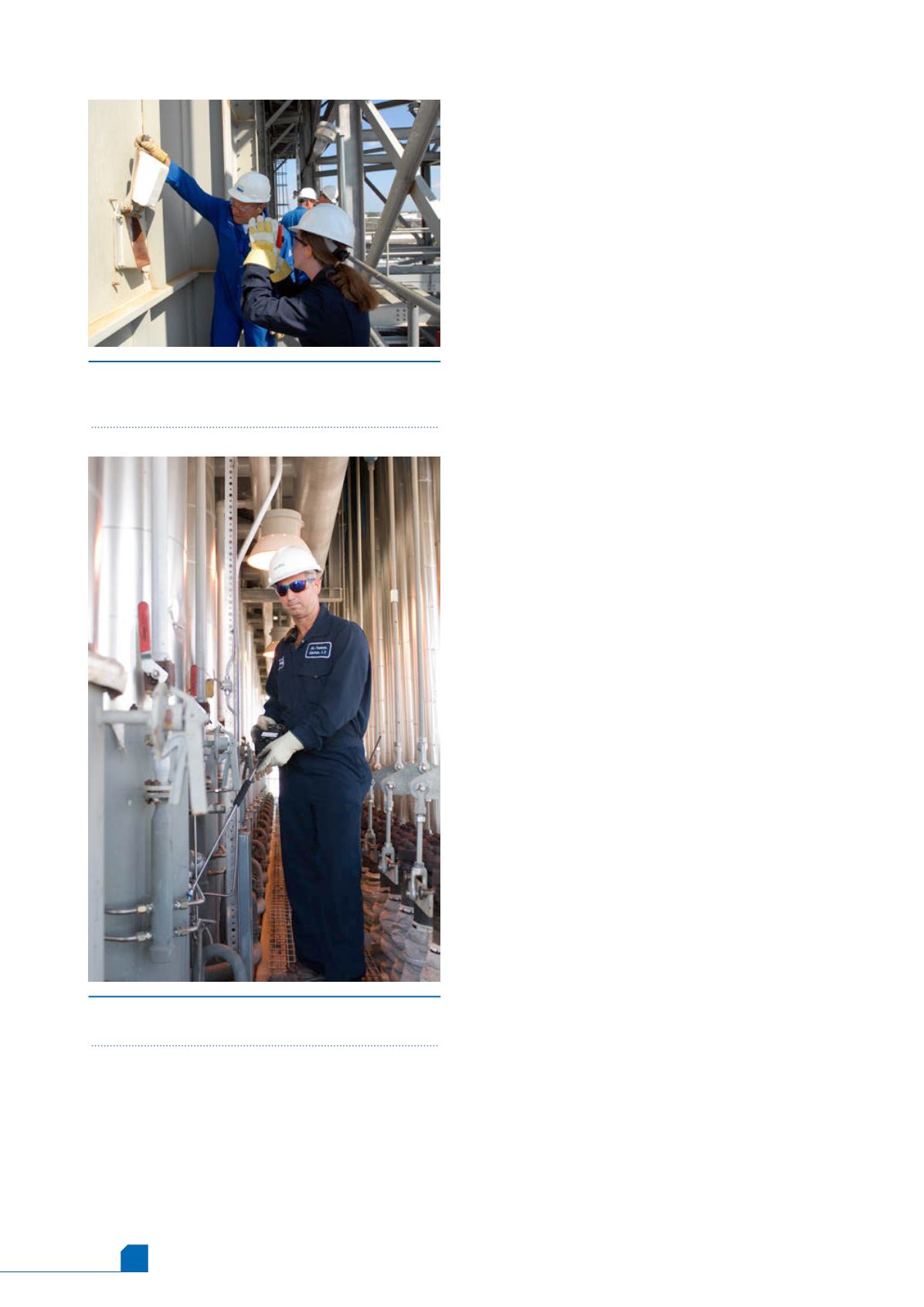
Figure 4.
An operator measuring reformer tube
temperatures inside the reformer box at the Sarnia,
Ontario, hydrogen plant.
Figure 5.
An operator checking the operating
conditions in the reformer penthouse at Sarnia.


