November
2016
HYDROCARBON
ENGINEERING
106
and contractors in the world, as Canada’s harsh climates require special
considerations in design, construction and operation to ensure optimisation
of the final gas and NGL products.
The plant in Figure 4 is a standard 200 million ft
3
/d sweet gas plant
located in northeast Alberta. This Seven Generations Energy project was
awarded to a Canadian engineering firm in April 2014. Through coordination
with the various contractors and construction teams, and cooperation with
the government regulators, the project only took 19 months (including
construction) through a Canadian winter.
Canada's gas processing and midstream industries are developed and
ready to support growth in the natural gas, NGLs and condensate customer
base. With sophisticated drilling programmes, which feed into the gas
processing plants and then into the current distribution system, these plants
are ready to transport their processed gases, NGLs and condensate to LNG
facilities on the Canadian coasts.
Customers
The Canadian natural gas industry essentially has two customers. There is the
domestic customer base in Canada, which is growing, and the US customer
base, which is decreasing.
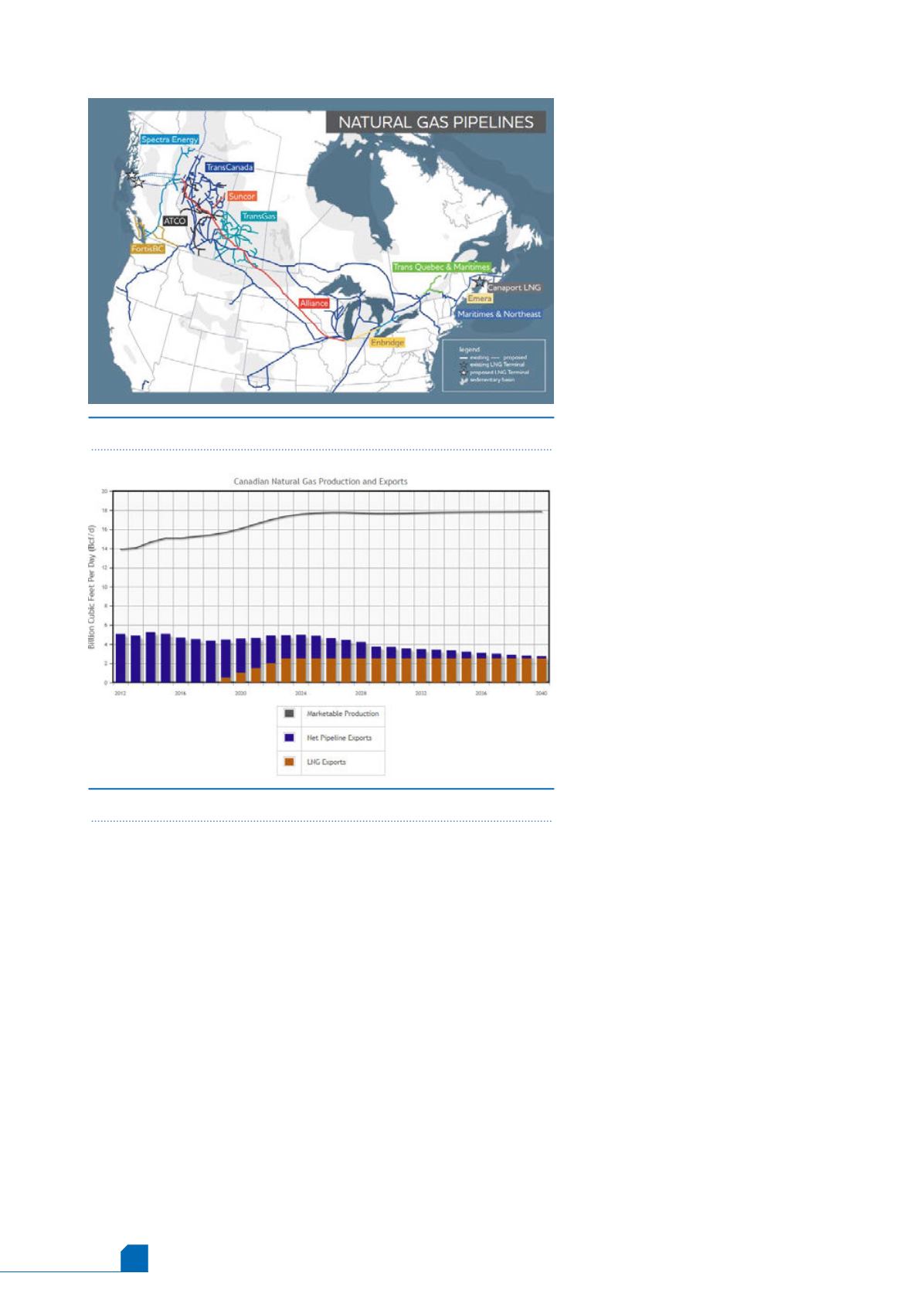
Figure 2.
Canadian natural gas pipeline network.
Figure 3.
Canadian natural gas production and exports.
As demonstrated in Figure 5, the trade
of natural gas to the US has been
decreasing rapidly since 2005 and is
projected to continue. The industry is
fully aware of this trend and is preparing
to adapt to this new reality. For the
foreseeable future, supply will outpace
demand in the North American
marketplace.
To make matters even more
challenging, the US is positioned to
become a net natural gas exporter within
a few years and has several LNG export
facilities in operation and under
construction. The US also expects to
export natural gas, by pipeline, primarily
into Mexico, as well as to eastern Canada
and its LNG plants, with Europe being the
primary target market.
Canadian LNG industry
The Canadian LNG industry is currently in
its infancy, but it has great opportunities
on both coasts. There are resources,
political stability, talent and the
workforce to implement these projects.
Through the proposed Canadian LNG
facilities on the west coast, natural gas
can be transported to the Asian markets
at a faster rate than any other LNG
facilities in the world.
The Canadian natural gas industry
understands what needs to be carried out,
as does the Canadian LNG industry. The
challenge is building some of these
projects under the current worldwide
natural gas supply and demand model.
Similar to North America, the world
prices for natural gas have declined,
which makes any new LNG projects less
likely to proceed. However, the oil and
gas industry is familiar with the volatility
of the world markets and these projects
require a longer outlook. Currently, many
multi-national oil and gas companies have
partnered up with Canadian producers to
build these LNG projects.
Where does the industry go
from here?
The solution is easy, however, executing,
funding and constructing it is challenging.
The country’s oil and natural gas reserves
are landlocked and well over 1000 km
from the nearest coast. The current
pipeline routes are primarily centralised
and generally run north to south,
accommodating Canada’s largest current
customer, the US. For Canada to be a
world class exporter of natural gas, NGLs


