November
2016
HYDROCARBON
ENGINEERING
14
overthrowing of the socialist regime. The
post‑communist upheaval led to a considerable drop in
refining throughput – only around 10 million tpy over
the last few years. The Romanian refining sector is
comprised of 10 plants, with capacities of 500 000 to
5 million tpy, yet most of the smaller refineries have
been closed down, or are operated at a very small
capacity utilisation.
Romania, like many other countries in the region, has
a national oil company, Petrom. At the end of 2004, an
Austrian oil company, OMV, acquired 51% of Petrom and
from January 2010 the company has been called
OMV Petrom. Initially Petrom operated two refineries,
Petrobrazi and Arpechim, with 4.5 and 3.5 million tpy of
capacity, respectively; however, in 2012, Arpechim
ceased to operate for economic reasons.
With OMV as majority shareholder, the company
focused on upgrading Petrobrazi. During the 2005 - 2015
period, total investment amounted to
€
1.2 billion.
Initial investment aimed at improving the quality of
motor fuels produced and bringing them up to Euro 5
standard – therefore, the revamping of the diesel
hydrotreatment unit and the construction of a new
fluid catalytic cracking (FCC) gasoline hydrotreating
unit. Larger scale investment followed with new
construction, including the revamping of a crude oil
distillation unit (CDU)/vacuum distillation unit (VDU),
delayed coking unit (DCU), FCC unit and other facilities,
as well as improving the plant in terms of energy
efficiency and environmental friendliness. Lately,
Petrobrazi has reached a steady throughput of
3.7 - 3.9 million tpy.
Another major player in the Romanian refining sector
is KMG International (KMGI), the owner of two
integrated refineries, Petromidia and Vega, with
capacities of 5 million and 500 000 tpy, respectively.
The company received its current name in 2014 – before
that it was called Rompetrol. Rompetrol’s acquisition by
KazMunaiGas, the national oil and gas company of
Kazakhstan, marked a major milestone in the company’s
history. Since 2009, KMG has been the sole shareholder
of Rompetrol.
Of all the refineries in the region, Petromidia is one
of the most modern, with construction completed in
1979. A modernisation programme that lasted from
2006 to 2012, and cost US$380 million, made the
refinery’s position even stronger. Thus, as per the 2015
results, it was Petromidia that refined almost 50% of all
the crude processed in Romania. As for Vega, it was
transformed from a conventional refinery into a
speciality products plant producing bitumen,
solvents, etc.
In April 2016, China Energy Company Limited (CEFC)
signed a memorandum of understanding to purchase a
51% stake in KMGI for US$680 million.
Another example of a Commonwealth of
Independent States (CIS) investor obtaining a share in
the Romanian oil refining industry is the Russian
independent oil and gas company Lukoil and the
Petrotel refinery. Lukoil has been growing its interest in
several steps. In 1998 it acquired a 62% stake in the
refinery, which had a capacity of 4.5 million tpy, for
merely US$53 million. Currently, Lukoil’s interest in
Petrotel is over 97%.
The initial entering price was that low for a reason
– the refinery asked for sizable investment. From
mid-2001 until the end of 2004 the refinery was out of
operation – it was undergoing modernisation that cost
around US$121 million and involved the construction of
an FCC gasoline hydrotreating unit and isomerisation
unit. The next step of modernisation, spanning
2005 - 2014, cost Lukoil US$540 million and made it
possible for the refinery to produce Euro 5 fuel. At
present, Petrotel has an estimated throughput of
2.4 million tpy. Though this performance is quite stable,
it is rumoured at times that Lukoil is planning to quit its
Romanian business – a series of conflicts between the
company and the Romanian state authorities appear to
fuel these speculations.
Yet another example of Former Soviet Union (FSU)
investors taking interest in the Romanian refining
industry is Onesti, a refinery with a production capacity
of 3.5 million tpy. In 2007 the 98% stake held by RAFO,
the refinery’s owner, was acquired by Austrian company
Petrochemical Holding GmbH, with Yakov Goldovskiy, a
Russian businessman, as its ultimate beneficiary.
Goldovskiy is a well known figure in the Russian
petrochemical industry. In the late 1990s he co-founded
the Russian petrochemical major Sibur and, since 1999,
he has been the chief executive officer (CEO) of the
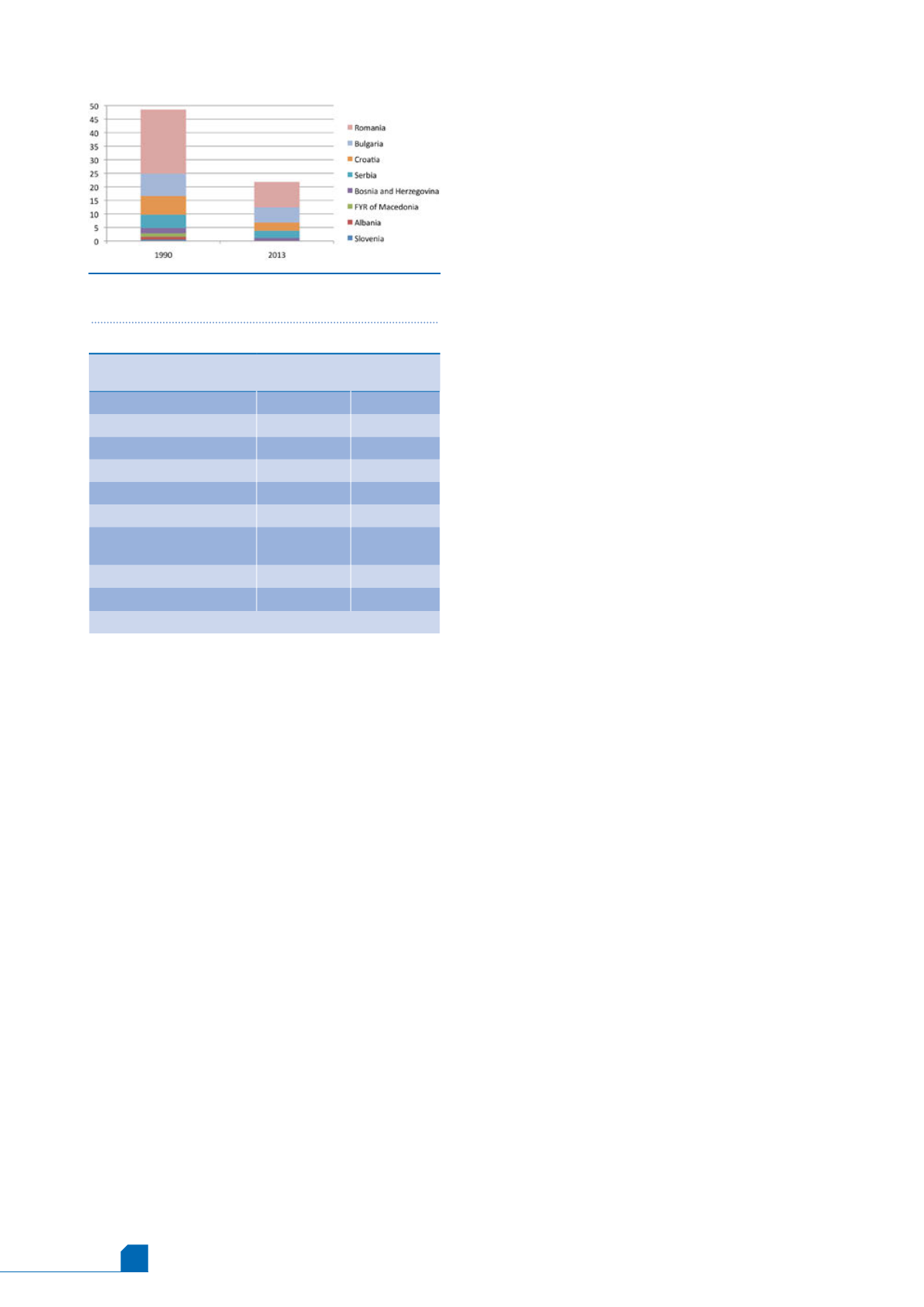
Figure 1.
Refining throughput in ex-communist Balkan
countries (million tpy).
Table 1.
Refining throughput in ex-communist
Balkan countries
1990
2013
Romania
23.7 million tpy 9.4 million tpy
Bulgaria
8.3 million tpy 5.6 million tpy
Croatia
6.9 million tpy 3.0 million tpy
Serbia
4.9 million tpy 2.7 million tpy
Bosnia and Herzegovina
2.0 million tpy 1.0 million tpy
Former Yugoslav Republic of
Macedonia
1.2 million tpy 60 000 tpy
Albania
1.1 million tpy 40 000 tpy
Slovenia
500 000 tpy 0
Source: IEA


